We’ll Always Be Misunderstood – The Politics Of Crossing Over
Dia Hakim Khaeri
Introductions
I’ve always been a bit of a bi-coastal person. Like most Singaporeans, I share a regular and steady relationship with The Second Link, a bridge that connects Singapore and Malaysia together. The act of crossing over, however, is a rather strange and nebulous thing to me. I adore travel, but I loathe it simultaneously. As I’ve taken charge of my own relationship to travelling as an adult, crossing over somewhere tends to come with a certain kind of baggage. It’s euphoric to step out of home soil, but even when you speak the same language, somehow a wall stands between me and Malaysia. I become too keenly aware of who I really am when I am crossing over – my prejudices, my energetic capacity, my social conditioning. I’ve worked in multiple countries, encountering so many different people – Japan, Taiwan, Scotland. Yet I still get surprised when the rest of the world doesn’t operate like my world.
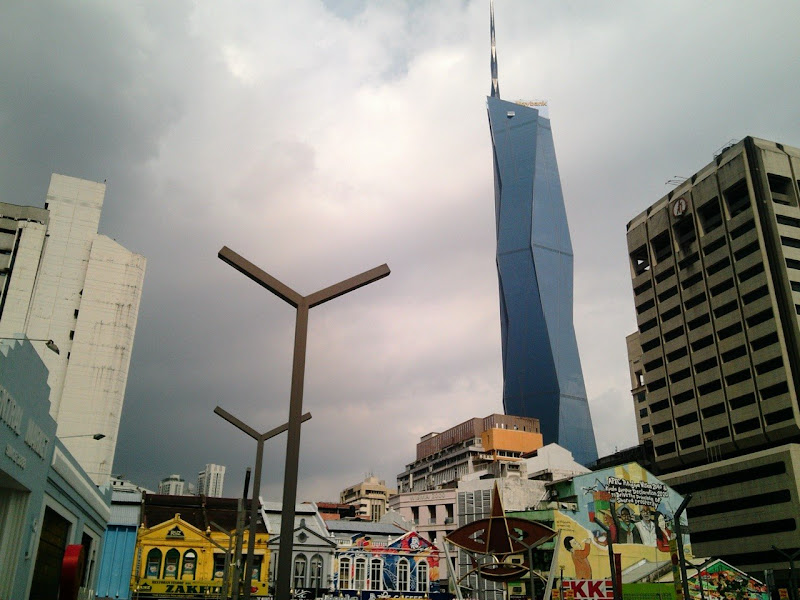
From my most recent trip to Kuala Lumpur just last month. A grey day didn’t stop Pasar Seni from being so vibrant. Photo by Dia Hakim
Throughout my time cross-bordering for work and leisure, a common factor has always been that no matter where I went, my collaborators often can speak English. I was spoiled in that respect. The world found itself a way to accommodate me still, through language and cultural imperialism.
When I work in Last Rites, director Xiaoyi crafted a team where releasing that colonial expectation is not an optional skill – it’s a necessity. I speak to intern Yue Yue – who is from Dali, China – through her phone. I cannot stop gushing about it being a huge technological marvel, being able to see my speech be live-translated on a sub-screen conveniently placed near the camera. When Mio, our Japanese interpreter, isn’t around, I speak to Kanji Shimizu in the little Japanese I know – polite ohayous in the morning, a concerned daijobu desu-ka? after a run. Even with our fellow Singaporean cast member Ser Pin, I can see how his thoughts run faster when he speaks in his Mandarin mother tongue. In this space, we are crossing over constantly in order to attain a semblance of being understood.
Emergency Stairs & ‘Crossing Over’
The act of ‘crossing over’ – which in itself is a nebulous, malleable term – is something that company founder Xiaoyi tends to revel in. “It’s a lot more than just a cultural crossing,” he remarks. I’ve nagged at him with more queries in our Whatsapp chat, shortly after meeting him for the first time at Al-Jilani’s. “It’s a traversal of spaces, art forms, identities, geographies.”
The company’s practice has spanned a rich tapestry of this methodology. For instance, the company can be seen celebrating the erosion of borders through programming like the Southernmost Project (2017-2019) and The Peripheral Experiment. Both programmes are ambitious events—one rooted in cross-cultural exchange and the other in cross-disciplinary exploration—that engage in the possibilities of new work, identities, and new knowledge production, as a result of new flows in cultural sharing and people.
On top of the physical act of gathering people of various countries and cultures together, the programmes also signal a deep desire to disrupt various aspects of being a professional artist. The basis of Southernmost Project emphasises dialogue and encounters, anchoring itself in process-driven, artist-centric, and Asia-based practices. While the overarching platform explores broader Asian cultural development and arts policy, certain specific collaborations, such as 2018’s Journey to Nowhere, have explicitly put these policies under scrutiny.
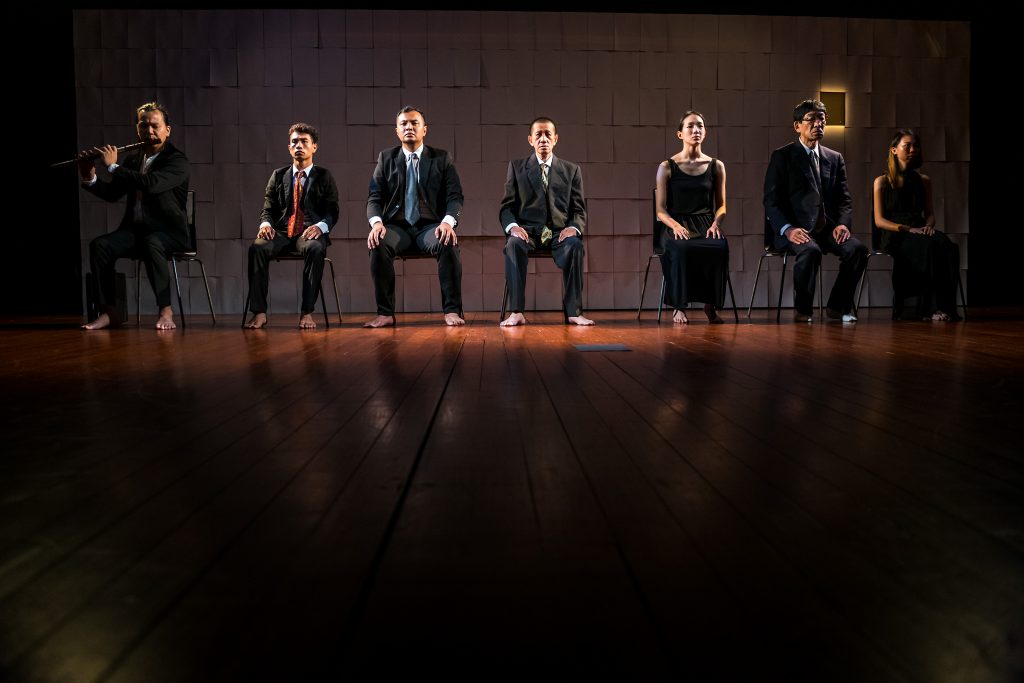
Photo: Southernmost Festival 2018, courtesy of Emergency Stairs. Kanji Shimizu and Didik Nini Thowok were collaborators here as well.
The Peripheral Experiment emphasises observation and presence through the nature of its impromptu-ness, labelling itself an ‘anti-festival’, resisting curatorial programming.
The company’s inception in a multi-cultural society like Singapore then also feels less and less like a coincidence. With the state’s noticeable lack of formally privileging specific cultural backgrounds in its nation building policy, Singapore then forms into a new site of social imaginings, fluid and agnostic.
Crossing over then becomes a site larger than just a company methodology – it is also a cultural and theatrical strategy. Performance, to Emergency Stairs, is often a site to be contested with. Challenged, picked apart, crossing itself over to form new meanings – often regardless of time, space and form.
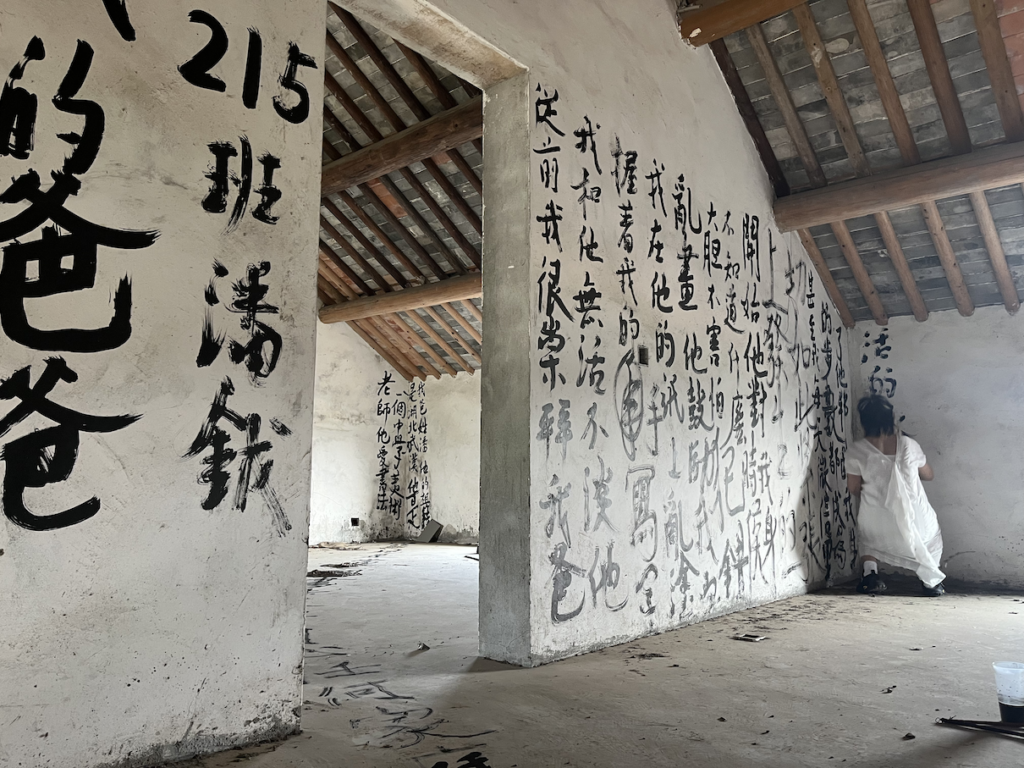
Photo: The Peripheral Experiment 2025. Credit: Emergency Stairs
Last Rites & Cross-Cultural Creation
To cross over is to be misunderstood. Especially in a world where border points and bureaucracy physically separate us from each other. To put multiple cultures in a room to interact, create and co-exist with one another will always be deeply political acts. When I watch the artists in Last Rites co-create, interacting with each other despite the different languages they exclusively communicate in, I’m reminded of the way that we hope to resist coloniality. When language and culture ‘erodes’ in the rehearsal room, performance becomes the universal language here, as bodies and histories collide to make a piece of work worth sharing. I see it in the way they don’t feel fear to negotiate with Xiaoyi, freely disagreeing and proposing alternatives. I see it in the way they teach each other how to don a Noh mask, warming up to a Kristin Linklater exercise in Korean, and watching a documentary together on Kuo Pao Kun in Mandarin.
The inevitability of misunderstanding then puts the entire creative team in a new spot. In my interviews with the performers, I’ve asked each of them about their entry points — why do they choose to be part of a highly contemporary work like this as ‘traditional’ performers?
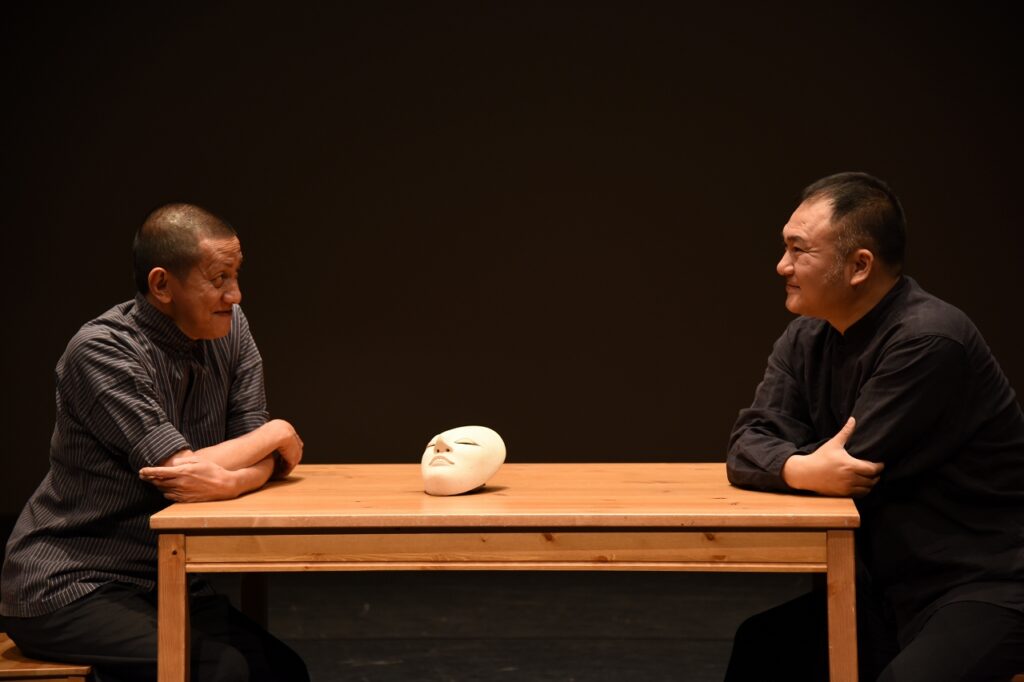
Photo: Journey to the South, One Table Two Chairs Meeting 2017, Tyoko (Directed by Liu Xiaoyi; Performed by Didik Nini Thowok (Yogyakarta) & Wang Bing (Nanjing)
Didik Nini Thowok, Xiaoyi’s longtime collaborator (the two first met at the 2014 Toki Festival before collaborating on Xiaoyi’s Journey to the South in Japan in 2017), cites that it’s the “freedom” of a process like this that excites him.
“We are all so different, but we can still work together. Don’t even understand the language we speak to each other, but still can. It’s very freeing,” he tells me with a knowing smile, one that signals that he revels in the difficulty of it. I see it through various creative compromises — for instance, giving Ser Pin clearer language cues through certain words in Bahasa Indonesia that share commonalities with Bahasa Melayu, so he can follow the rhythm of Didik’s performance and respond truthfully as an actor.
For collaborators like Shimizu (whom Xiaoyi first met at the 2013 Toki Festival, leading to their first collaboration in Japan for the 2018 production Journey to Nowhere) , where non Western elements are non-existent within Noh, he cites the hierarchy of director-actor as a pull factor to the process. “In Noh, the director is nonexistent. We make shows together, from scratch, which does make it more interesting for audiences sometimes as there’s a certain synergy to that process. But without a director, there’s also a unique tension [between performers] that exists that this space mitigates. To be able to really rehearse and refine the process is quite a journey to perform.”
How about Korean performing artists, Jung and Nam, whose collaboration with Xiaoyi only begins from 2024?
“It’s not a challenge for me per se… but it’s different. The pace for me is the stark thing. I’m younger than them, so I adapt to the slowness of the environment.” Nam muses. “But the work isn’t difficult. Just different. Every performance for me is a beginning. I can hardly think about what is ‘last’ for me yet.”
For Jung, it’s about philosophy. “Depending on the show, I’m always choosing something difficult, usually… I like to be challenged. But the important thing is I’m committed to the philosophy behind it. So in Last Rites, I found myself participating more dramaturgically. But I’m not a professional,” he says with a shy laugh. “Please don’t forget to bring in the professionals!”
It is clear then, that the concept of ‘crossing over’ is also looking beyond the act of meshing them together. The performers of Last Rites are also keenly aware of new creative processes that are organically generated — some drawn from traditional Western conventions, some taken from their own practices.
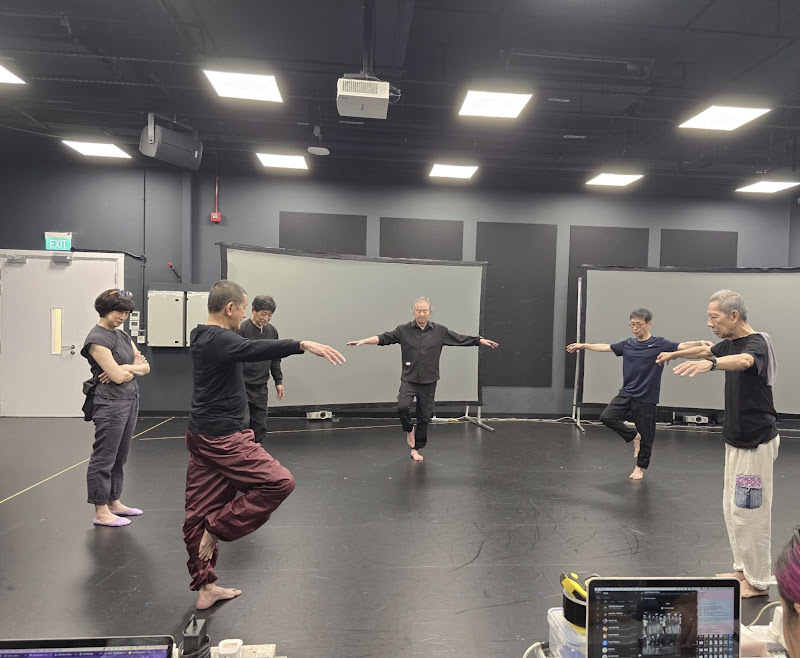
Cast warming up together during rehearsals. They rotate the leader who sets the warmup each day. Photo by Wan Sze, ENG-KOR interpreter.
The Politics of Crossing Over
Yet walls still exist even when we try to ignore them. The actors still have to speak through interpreters, who then re-communicate their thoughts back to English. English, the cursed universal, imperial language that still rules our rehearsal rooms, our theatre-making process, often the system that most non-Western theatre-makers seek to break out from. I wonder then if there can even really be a universal mode of theatre. Our bodies and minds are not neutral, they come with predisposed beliefs and systems ingrained in them.
I wonder then, in the quest to achieve the act of crossing over, if even this methodology can also be rife with bias – not just with Emergency Stairs, but within ourselves, as an increasingly globalised arts practice. In writing this, I wondered about how much “intercultural” exchange really happens within our own performance scene. The dominant language of theatre in Singapore remains English, even if we fit creoles like Singlish into our scripts. Our gaze as creators is then a point of contention here, as we bring people together to create a new universal language. What do we want the audience to see? What do they gain or lose when a dominant voice is orchestrating these cultures onstage, and why?
The very location of Singapore also risks a sense of cultural dilution, in the attempts to cross over. As Southernmost itself references certain arts policies, Singapore’s general attitude to organisation and time-keeping affects the way we bring other cultures into our scene. A dear friend from gamelan group Klenengan Singa Laras articulated this in a passing conversation we had about staging gamelan in Singapore – there is really no such thing as an authentic gamelan performance when a performance can only be confined to a set number of minutes. The very act of start and end time in our performance structures also signal the coloniality that still persists. To cross over is to acknowledge that baggage. We don’t cross over without acknowledging our differences, and we certainly cannot cross over when we forget that walls already exist, without our consent. Not because we want them there, but we have the responsibility to ensure they get taken down, as much as possible.
Conclusion
What then, does it mean, to truly cross over? I don’t think Emergency Stairs hopes to really arrive at a solidified answer. With a history of constant experimentation, inquiry and a trial-and-error mentality, I doubt that the answer is really the priority. Perhaps my hope for one is also a form of coloniality, as I seek comfort in the things that I know are definitive.
In the meantime, we create, we gather, we live, and eventually, we die. I find peace in that my chosen art form, wherever it is made in the world, is ephemeral. Once it is lived, it dies immediately, into a world of uncertainty, in the air it breathes, in the space it occupies. We’ll never have the answers. But hopefully, we’re brave enough to cross the bridge when we get there. To be uncomfortable with each other even when our walls are up. To continue to smile and make an effort. To live.
References
https://artsequator.com/southernmost-2018/
Cozma, Diana. (2021). Towards a Universal Language of Theatre. Theatrical Colloquia. 11. 32-49. 10.2478/tco-2021-0018.
https://thefunambulist.net/magazine/article/time-and-the-colonial-state
Ruppin, D. (2017). The Emergence of a Modern Audience for Cinema in Colonial Java. Bijdragen tot de taal-, land- en volkenkunde / Journal of the Humanities and Social Sciences of Southeast Asia, 173(4), 475-502. https://doi.org/10.1163/22134379-17304014